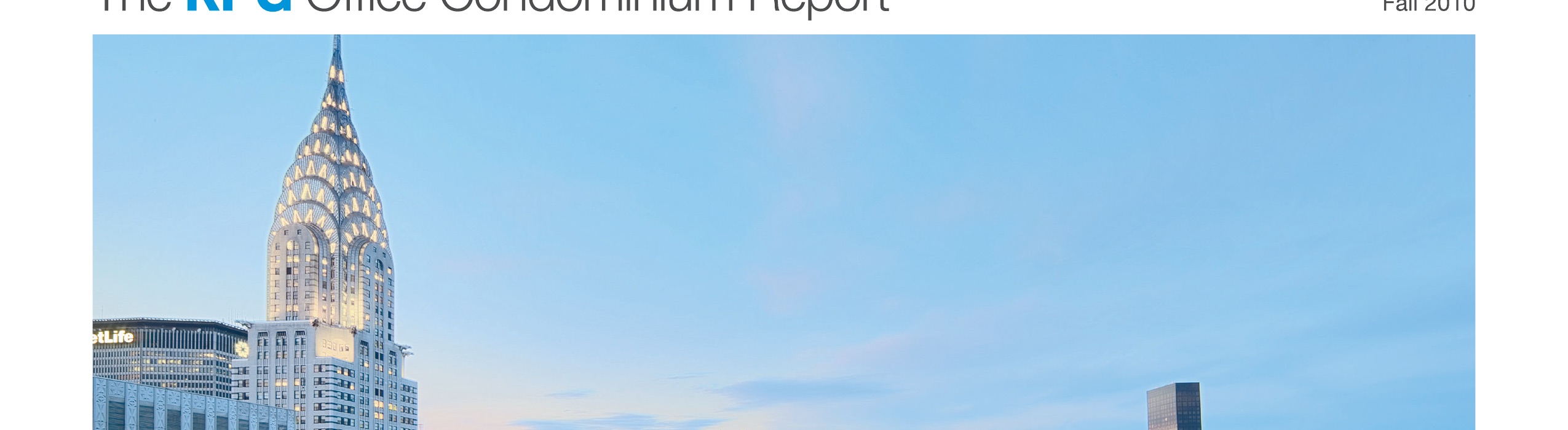
NYC Office Condo Market Report — Second Half 2010
Semi-annual analysis of Manhattan office condominium sales and trends for the second half of 2010.
Download PDFMarket Overview
2010 Manhattan Office Condominium Sales
Through November 2010 there were a total of 305,650 square feet of office condominium sales in Manhattan totaling $173,165,061. The sales averaged $567 per square foot. There were a total of 65 office condominium units sold in 31 different buildings, averaging 4,702 square feet per sale.
Square Footage of Sales
Through November 2010 there were 305,650 square feet of sales compared to 220,089 square feet in 2009. There has been a 39% increase in total square footage sold in 2010.
Dollar Value of Sales
Through November 2010 there were $173,165,061 in sales compared to $158,188,680 in 2009. There has been a 9% increase in the dollar value of sales.
Average Price Per Square Foot
Through November 2010 the average price per square foot was $567, compared to $719 in 2009. The five year average price per square foot is $591.
Number of Sales
Through November 2010 there were 65 sales compared to 70 sales in 2009. The sales occurred in 31 different buildings and the average size of the units sold was 4,702 square feet.
Submarket Statistics
The Midtown submarket is Manhattan's largest office condominium submarket, comprised of 4.7 million square feet. Through November 2010 there were 21 sales totaling 133,787 square feet. The dollar value of these sales totaled $77,911,983, averaging $582 per square foot.
Notable sales in this submarket include an 11,850 square foot sale at 420 Fifth Avenue, one of Manhattan's few Class A office condominium buildings. The purchaser was Unipec America, Inc., a subsidiary of China's largest oil trading company. The company paid $721 per square foot for a unit on the 27th floor. 420 Fifth Avenue was built in 1988. In 1992 the Girl Scouts of the U.S.A. purchased 170,000 square feet for approximately $140 per square foot. In 1993 the Rockefeller Foundation purchased 87,500 square feet on five floors for approximately $170 per square foot.
The Midtown South submarket is comprised of approximately 2.5 million square feet of office condominiums. Through November 2010 there were 23 sales totaling 112,779 square feet. The dollar value of the sales totaled $64,407,194, averaging $571 per square foot.
Five of the sales occurred at 98 East Broadway, a 23,283 square foot, newly constructed office condominium in the Chinatown submarket. The sales totaled 15,744 square feet and sold for $10,710,000, averaging $679 per square foot. The Chinatown submarket has historically garnered a premium price per square foot. The neighborhood boasts 100,000 residents with an additional 20,000 daily commuters and over 4,000 Chinese-owned businesses. Another recent Chinatown office condominium conversion at 139 Centre Street averaged over $1,000 per square foot. The 151,000 square foot building was sold primarily to medical professionals serving the Chinatown community.
The Downtown submarket is comprised of approximately 1 million square feet of office condominiums. Through November 2010 there were 21 sales totaling 59,084 square feet. The sales totaled $30,845,884, averaging $522 per square foot.
In October 2010 the 25,622 square foot, 9th floor of 125 Maiden Lane was sold for approximately $350 per square foot. The purchaser, the International Planned Parenthood Federation, joins the building's roster of non-profit office condominium unit owners, such as the US Fund for UNICEF, The Forward Association, Inc. and the Guttmacher Institute. Non-profit organizations continue to be active purchasers of office condominiums, partially to take advantage of the real estate tax exemption associated with ownership.
Market Trends
Dollar Volume by Half Year
Total sales volume per period
Average Price per RSF
Volume-weighted avg vs median $/RSF
Office Condos Sold
Number of transactions per period
Sales by Submarket
Total volume by submarket (all time)
Available Inventory
Current listings by submarket
| Submarket | Buildings | Listings | Available RSF | Avg Ask/RSF |
|---|---|---|---|---|
| Midtown | 29 | 116 | 1,052,616 | $926 |
| Midtown South | 34 | 56 | 346,840 | $778 |
| Downtown | 22 | 78 | 351,106 | $1,002 |
| Total | 85 | 250 | 1,750,562 | $916 |
New FASB Accounting Rules Make Office Condominiums Even More Compelling
By Rudder Property Group
New accounting standards, set by The Financial Accounting Standards Board ("FASB"), are in the works. These new rules will have a dramatic affect on the commercial real estate market and will make office condominium ownership even more appealing. The FASB ruling, which is expected to be put into effect in 2013, will require companies to recognize new and existing lease payments as a liability on their balance sheets. Currently, a company's lease obligations are not recognized as a liability in the financial statement. Rather, the terms of the lease are disclosed in the footnotes of the financial statements. The accounting change is meant to bring an end to off-balance sheet activity for leases.
According to the June 22, 2010 New York Times article "New Accounting Rules Ruffle the Leasing Market", the new FASB standard will have an estimated $2 trillion impact as companies will have to record their lease payments as a significant liability on their balance sheet. Under the new ruling, the longer the term of a company's lease, the greater the liability the company will have to record. If a company has a 10-year lease it has to record twice the amount of liabilities on its balance sheet versus a 5-year lease, which means companies will be motivated to sign shorter term leases. In addition, if there is a renewal option that is expected to be exercised, the company will have to record the renewal term as an additional liability. If a company has a 10-year lease with a 5-year renewal option, its balance sheet will have to reflect 15 years of lease obligations.
Even as the economic climate continues to improve, many companies are burdened with poor financials and heavy debt. According to Shahab Moreh, a partner with accounting firm WeiserMazars LLP, "Additional liabilities on the balance sheet for these companies will impact debt covenants with lenders, alter investor perception, and possibly affect credit ratings."
Now more than ever, companies are considering the option to own their space. If off-balance sheet activity for leases will no longer be allowed, companies will look to reap the benefits of ownership, which includes equity growth, tax advantages and potential capital appreciation.
---
Interview with Fred Gammon, President, Gammon Ragonesi Associates
Fred Gammon, President of Gammon Ragonesi Associates, purchased 6,333 square feet on the entire 16th floor at 131 West 33rd Street in January 2010.
Provide us with some background on your company. Where were you located prior to your purchase?
Gammon Ragonesi Associates is a 22 year old, creative branding and promotions company. Prior to purchasing we rented an office on Madison Avenue. We have many clients outside of New York and felt that it was important for us to be identified by our Madison Avenue address. We renewed our lease twice at that location and both times felt that the renewal terms were reasonable and fair. Our third renewal came about two years ago. While our landlord was willing to renew, the pricing was going to be over 60% more than what we were currently paying.
At this point our reputation was more important than our address, so we decided that we would make a geographic switch and seek a lower-cost leasing opportunity. Even in lower-cost locations we found the leasing market to be over-priced, so we decided to explore buying opportunities.
Tell us about your search and the process of buying.
At first we did not think we could afford to buy our space, but we were referred to several banks who said that they could get us very low interest rate financing where we wouldn't have to put down a lot of capital.
We pursued many different properties to purchase, but we faced several challenges. The first challenge was that we were trying to buy commercial co-ops. We found that co-op boards, particularly in commercial buildings, are difficult, and we got a lot of rejections. Another challenge we faced was financing. We were trying to secure 90% financing, including our build out costs. As the market was on a downward trend there were fewer comparable sales that a bank could use for appraisal purposes.
Tell us about your purchase.
Despite these challenges, we ultimately purchased an entire floor at 131 West 33rd Street. We were able to buy at around one-half of the per square foot rate that we expected to pay two years earlier. Also, we were able to buy in a better building at a better location. We feel that the low price and better building makes for greater capital appreciation potential. We were able to secure our desired amount of financing through an SBA lending program.
What advice do you have for prospective purchasers?
After a two year process I realized that in order to purchase you have to have endurance. There are many pieces that have to come together to make a deal. I recommend that you do a lot of research. While there are many so called experts, the best way to research is by speaking with someone who has already purchased an office condominium and has been through the process. I also recommend having a qualified assistant help you with all of the research and pre-purchase work.
What are your thoughts on the market right now?
If you can afford it, I think it is a great time for a company to buy their office space. Prices are down, financing is readily available for those who qualify, and interest rates are low. We figured that by owning over the next ten to twenty years we could build equity and lock in our occupancy costs.