
Real estate prices for office condominium units in New York City have decreased substantially. This is good news for nonprofit organizations hoping to advance their mission and expand or consolidate programming in upgraded space. A window of opportunity is opening in an otherwise tight real estate market, and now is the time to take advantage by combining available financing options to fund new acquisitions.
During the previous 30 months, interest rates have more than doubled. In response, many nonprofits are reluctant to undertake large capital projects, but is the sensible move to delay real estate investments until economic conditions improve? Not necessarily.
The current economic environment, although still challenging, has produced a buyer's market—at least for the short-term.
Waiting for interest rates to go down substantially poses the risk of missing out on a sizable Class-A office condominiums at favorable prices. Demand for CRE may be low for the moment, but this will quickly change as the quantity of quality office spaces diminishes.
The Capital Project Financing Equation

Many different project drivers can be behind large capital investments, including acquisitions and renovations of new project facilities, investments in leasehold improvements, machinery and equipment, and refinancing high-cost debt. Nonprofits should approach capital project financing in a similarly holistic manner—using a financing equation with multiple components.
Nonprofits can tap into a range of financing options. In addition to capital campaigns, organization equity, and of course debt financing, we encourage our clients to consider city, state and federal capital grants, subsidized government financing, incentives, and tax credits. Programs like these are often how a project financing capital stack is ultimately completed.
Two Examples of a Creative Office Condominium Financing Options
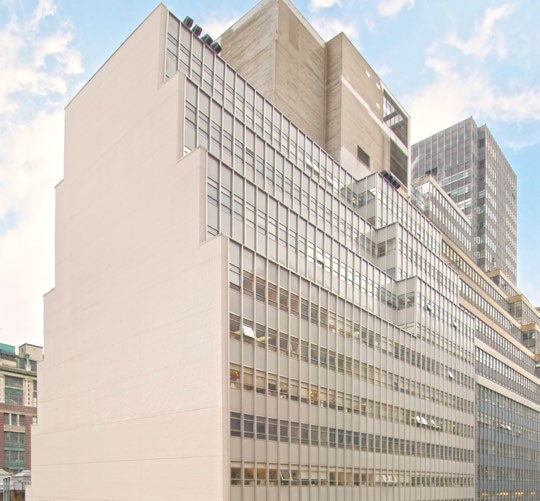
It takes a mix of financing options to make most projects financially feasible. The following two projects demonstrate a few possible combinations. In each case, our nonprofit client acquired a Class-A office condominium space in Manhattan.
Low-cost capital markets financing can achieve up to 100% of your project costs. Tax-exempt bonds are typically secured for projects of $10M or more.
The Orthodox Union, a first-time borrower, had outgrown its current leased space, which was both outdated and ill-equipped to support expanded programming. Although remaining in New York presented some financial challenges, leaving the city during a time of economic upheaval and uncertainty was not an option.
Capital grants can fund as much as 90% of your capital improvements for projects up to $2.0 million and 50% for costs of more than $2.0 million. Consider how NYC and NYS-programs impacted our client, the New York Immigration Coalition, an umbrella policy and advocacy organization representing 200+ immigrant and refugee rights groups throughout New York.
Why Nonprofits Benefit from Owning Property

Owning your office space is attractive on many levels. Nonprofits rely on effective long-term financial management to ensure uninterrupted resources for staff to pursue mission-related activities. Significant, unexpected increases in occupancy costs, upon lease renewal, can derail the best of strategic financial plans.
In addition to gaining some certainty in a fluctuating rental market, office condominium acquisitions represents an opportunity to design space to fit exact, often specialized, requirements, including community programming and fundraising. Furthermore, owning (versus leasing) means having an asset with no real estate taxes, which increases in value over time. It's a decision with lasting positive impacts for an organization. In short, property ownership leads to more possibilities.
Unlocking Value in Distressed NYC Office Buildings through Office Condominium Conversions
The office market in New York City has been under significant pressure, experiencing skyrocketing vacancy rates and plummeting rents. These challenging conditions have left many office building owners facing an uphill battle to cover their mortgage payments and meet loan maturity deadlines.
Amid these challenges, office building owners should turn to office condominium conversions as a strategic solution. The benefits of this approach are multifaceted and can be particularly advantageous for landlords of distressed, overleveraged properties.
One of the key benefits of an office condominium conversion is the opportunity for landlords to monetize vacant space. By selling off individual units, landlords can generate capital to reduce their debt load while maintaining ownership of the occupied parts of the building, preserving a steady income stream.
Office condominium conversions also allow landlords to reach a broader buyer base. The NYC market is home to a plethora of small businesses, tax-exempt nonprofit organizations, government entities and medical professionals who are more interested in owning, rather than leasing, their office space. Offering units for sale helps landlords tap into this potential market.
The concept of the sum of the parts being greater than the whole holds true in real estate, and office condominium conversions are no exception. This strategy allows landlords to achieve a higher aggregate price than would be possible if they sold the building as a single entity. This is a compelling way for landlords to unlock the latent value in their buildings.
In summary, office condominium conversions present a viable strategy for distressed, overleveraged office building owners in New York City. By selling off individual units, landlords can alleviate their debt, tap into a new pool of potential buyers, and potentially realize a higher aggregate value from their buildings.
While this strategy offers significant potential advantages, it also comes with its own set of challenges and requires careful planning and strategic execution.