In March, prominent landscape architect Ken Smith purchased an office cooperative in a loft-like space on West 31st Street near the newly-opened north section of the High Line. The 11,800 square foot floor was purchased for $2.6 million. Ken Smith's dream of owning his office space became a reality with the help of financing that he obtained through Bank of America. The availability of financing made office ownership a reality for Ken Smith. Today's low interest rate environment made the cost of owning less than the cost of renting. Mr. Smith's monthly carrying costs, including his maintenance fees and mortgage payments, are approximately 15 percent less than what he was paying in rent.
Commercial real estate lending in general has certainly seen its fair share of tough press since the recession, and for good reason. The landscape for investment property lending has certainly changed over the last few years, most notably due to the relative absence of the CMBS market which has forced banks to take a more selective approach.
Ken Smith's case, however, represents a very different market reality in Manhattan where activity and lending has actually picked up since start of the recession. The office condominium market is a small but growing niche in Manhattan and is typically marketed towards owner users and small businesses. The combination of falling prices, low interest rates and 90 percent financing has made owning a reality for many companies.
Since the beginning of the recession the SBA program has been substantially improved. Through increased government efforts to ensure the flow of financing to small businesses, such as the American Reinvestment Act, it's now easier than ever for more businesses to obtain financing for office condominium acquisitions.
Some of the changes to the SBA loan program include:
Increased loan size: SBA loans can be up to $15 million, and even higher in some instances. Historically, SBA financing was only thought to be for much smaller loans.
Broader eligibility requirements: The program no longer has a restriction on company sales size. It now allows for businesses with up to $15 million in tangible equity and a two year average net income of up to $5 million. These new ceilings are double the size and create a much broader definition of "small business."
Green projects: The SBA will provide additional financing for projects that involve energy-efficient improvements.
Some of the advantages of using the SBA loan program include:
Quick and easy process: A banker can generally provide an overview of how much they will lend a business within 30 minutes of reviewing the purchaser's financial statements. Most office condominium purchasers who are getting an SBA loan close on the sale within 45 days of contract execution.
Low cost: Extremely low interest rates combined with a recent reduction of upfront fees make the annual carry costs of ownership less than the cost of renting. Ken Smith's interest rate averaged 5.5% for a 20 year term.
High loan-to-value: SBA loans frequently cover up to 90% of the purchase price. The build out and soft costs such as mortgage recording tax and title insurance are financeable as well.
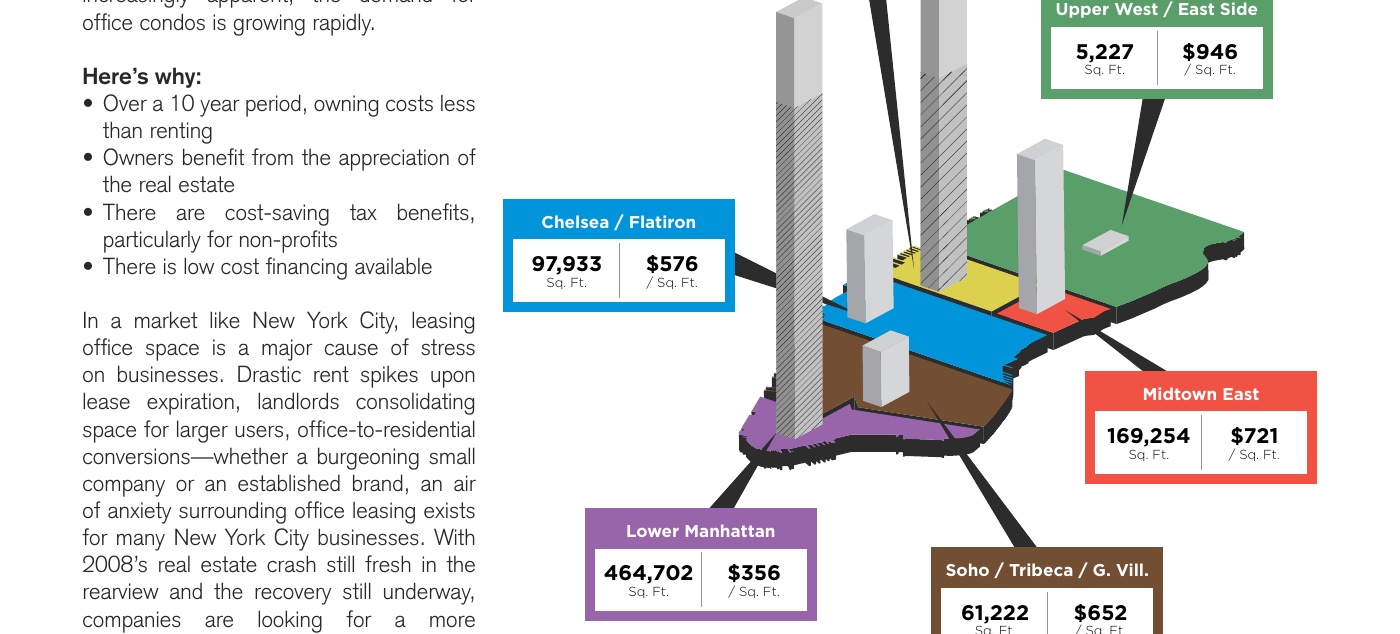
The Manhattan office condominium and co-op market is still relatively small, making up approximately 2 percent of the 500 million square foot office market. However, more commercial tenants are becoming owners. They are capitalizing on low real estate prices, favorable loans and a growing availability of office condominium space.
The Buy vs. Lease Financial Analysis
There are many factors that go into the decision of buying an office condominium versus leasing an office space. The financial implications are obviously one of the most important factors in the buy versus lease decision.
In making the buy versus lease decision, a financial analysis is used to identify the advantage of one alternative over the other. The principal focus of the analysis is to choose the alternative that will provide the needed space at the least net cost. To determine this, the annual carrying cost and benefits of owning the property are compared with the annual carrying cost of leasing the space. All other things being equal, the course of action with the least net cost is chosen.
For the purposes of the chart and analysis below an actual office condominium is used as the subject property. The subject property is the 18,201 Sq. Ft., 14th floor of 125 Maiden Lane, which is currently being marketed for sale by Rudder Property Group.
The basic elements of the buy versus lease financial analysis are based on a 10 year occupancy cost study. Assume the office condominium is purchased for $350/Sq. Ft., and the annual carrying costs including common charges and real estate taxes are approximately $14/Sq. Ft. The annual mortgage expense, based on a 75% loan at a 5.5% interest rate fixed for a 20 year term, is approximately $22/Sq. Ft. The annual cost to purchase and carry the office condo is $36/Sq. Ft.
The market lease rate for the 14th floor of 125 Maiden Lane is approximately $32/Sq. Ft. By the sixth year of the lease, the rate will have escalated to $38/Sq. Ft. By the sixth year the escalated lease rate will be higher than the escalated annual cost of owning.
This own versus lease analysis does not even take into account the potential appreciation of the value of the office condominium and any additional tax benefits. Over a 10 year period it will actually cost less to buy the office condominium than it would be to lease the same space.
Recent Sale Rudder Property Group
Rudder Property Group recently completed a $2,227,560 sale of two contiguous office condominium units at 36 West 44th Street, also known as The Bar Building. RPG represented the seller TGG Holding, LLC, a real estate investment group, and the buyer was Jade Holdings Group, LLC.
Jade Holdings, whose main office is based in China, was looking to open their first U.S. office. While many local small business owners were hesitant to purchase due to the uncertain economic times, Jade saw the opportunity to buy their office instead of renting since pricing was low and they could benefit from the long term appreciation.
The Bar Building is one of Manhattan's most prominent office condominiums and is situated on the most prestigious block in Grand Central next to the Harvard, Penn and New York Yacht Clubs, as well as many luxury hotels. The building has a luxurious 24/7 attended lobby, excellent light and views, efficient column free spaces and it recently completed major capital improvements including brand new elevators.